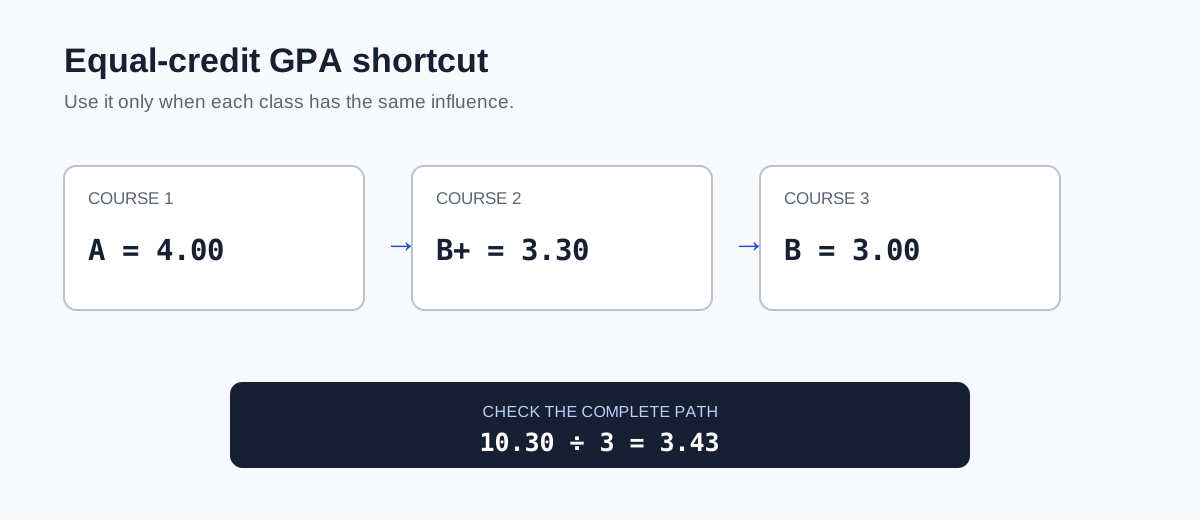
You do not need to enter credits when all included classes count equally. In that special case, each grade point has the same mathematical weight.
Equal-credit formula
Worked example
| Course | Grade | Grade points |
|---|---|---|
| English | A- | 3.7 |
| Math | B+ | 3.3 |
| Science | A | 4.0 |
| History | B | 3.0 |
When is the equal-credit shortcut wrong?
Suppose the A course is worth half a credit while the other three are worth one credit. The direct average still treats it as a full course, so it overstates that grade's influence. Use quality points whenever credits differ.
Equal-credit and credit-weighted results compared
| Course | Grade points | Credits | Quality points |
|---|---|---|---|
| English | 3.7 | 0.5 | 1.85 |
| Math | 3.3 | 1.0 | 3.30 |
| Science | 4.0 | 1.0 | 4.00 |
| History | 3.0 | 1.0 | 3.00 |
The unweighted shortcut still returns 3.50 because it averages four grade-point values. The credit-weighted method returns 12.15 ÷ 3.5 = 3.47. The difference is small in this example, but it can grow when half-credit courses, labs, or year-long classes carry very different grades.
Use the GPA calculator without credits only after confirming equal course value. If credits are available, use the credit-weighted high school or cumulative calculator instead.
How can you tell whether classes have equal credit?
- Look for credits, units, or GPA hours on the report.
- Check whether year-long and semester courses carry different values.
- Confirm whether labs and one-period electives are weighted differently.
- Ask whether repeated or pass/fail courses enter the GPA denominator.
Compare the shortcut with one-credit entries
A practical way to verify the shortcut is to assign one credit to every class and run the normal quality-points formula. The result should match the direct average exactly. If it does not, a course was omitted, a grade-point value differs, or one class has been given extra weight.
Keep weighted GPA separate. Equal credits do not remove AP or Honors bonuses when the school applies them; they only remove the need for different credit values.
Missing credit data is not proof of equal credit
If the report omits credits, check the handbook before assuming every course is identical. An unofficial estimate should say that equal credits were assumed.
Why the equal-credit shortcut works
In a credit-weighted GPA, every course contributes grade points multiplied by credits. When every course has the same credit value, that value appears in every numerator term and in the denominator. It cancels, leaving the sum of grade points divided by the number of courses.
One unequal course breaks the shortcut
If three classes carry one credit and a fourth carries half a credit, the common factor no longer exists. A simple four-course average would give the half-credit class the same influence as each full-credit class. Switch to the credit-weighted formula even when the difference seems small.
| Course setup | Safe method | Reason |
|---|---|---|
| Every class is 1.0 credit | Simple grade-point average | All weights are equal |
| Every class is 0.5 credit | Simple grade-point average | All weights are still equal |
| Mix of 0.5 and 1.0 credits | Credit-weighted GPA | Course influence differs |
| Credits are unknown | Label as a rough estimate | Equal weight is an assumption |
Before using the shortcut on a transcript, also confirm that every listed grade is included in GPA. Equal visible credits do not override pass/fail, withdrawal, repeat, or transfer-credit rules.
A four-pass check for this method
A reliable gpa without credits estimate should leave an audit trail, not just a final number. Work through these four passes in order and keep the source for every scale, weight, credit value, and inclusion decision beside the calculation.
- Confirm that every included class carries the same GPA weight.
- Convert each final grade with one documented point table.
- Add the grade points and count the included classes.
- Divide by the class count and preserve the unrounded value.
After the four passes, change one input at a time and calculate again. The direction and size of the change should match the rule you documented. Preserve unrounded values until the final display, label hypothetical inputs, and keep institutional results separate from estimates created for planning. If the worksheet still disagrees with an official record, compare the included courses and denominator before assuming the arithmetic is wrong.
Assign one credit to every included class and run the full quality-points formula. It should match the direct average exactly when the equal-credit assumption is valid. Save the source date with the worksheet so a later policy change does not silently alter the meaning of the estimate.