A college GPA is not usually a simple average of four letter grades. A four-credit laboratory course affects the result more than a one-credit seminar because the grade points are multiplied by credit hours.
Calculate it course by course
- Find the institution's grade-point table.
- Multiply each course's grade points by its GPA credit hours.
- Add the quality points and GPA hours.
- Divide total quality points by total GPA hours.
Worked semester example
| Course | Grade | Points | Credits | Quality points |
|---|---|---|---|---|
| Composition | A- | 3.67 | 3 | 11.01 |
| Calculus | B+ | 3.33 | 4 | 13.32 |
| Psychology | A | 4.00 | 3 | 12.00 |
| History | B+ | 3.33 | 3 | 9.99 |
| Total | 13 | 46.32 |
Which credits may not enter GPA?
Attempted credits, earned credits, and GPA hours can differ. Pass grades, withdrawals, audits, and transfer work may award or show credits without adding grade points. The University of Illinois, Indiana University, and UC Berkeley publish different details for their own records, which is why the registrar rule must control.
How do you add a semester to a cumulative GPA?
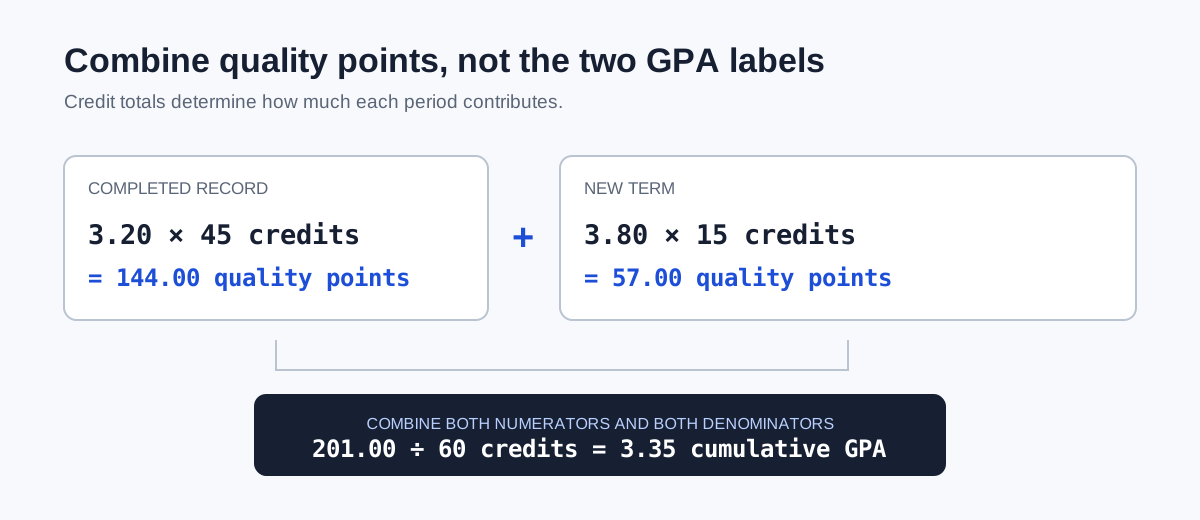
Convert both records back to quality points before combining them. Do not average the old cumulative GPA and the new semester GPA unless both represent the same number of GPA hours.
Worked cumulative GPA example
A student begins with a 3.40 cumulative GPA across 60 GPA hours. That record represents 204.00 quality points. The new 13-credit semester above adds 46.32 quality points.
| Record | GPA hours | Quality points |
|---|---|---|
| Previous cumulative record | 60 | 204.00 |
| New semester | 13 | 46.32 |
| Combined | 73 | 250.32 |
This example also shows why a strong single semester moves a long transcript gradually. Use the cumulative GPA calculator to combine an existing record with planned courses while keeping credits and quality points visible.
Audit the transcript inputs
- Use GPA hours, not automatically the attempted or earned credit total.
- Preserve the institution's plus/minus values rather than substituting a generic scale.
- Check how repeats, academic forgiveness, incompletes, withdrawals, and transfer grades are displayed.
- Keep institutional GPA and application-service GPA calculations separate.
Application services can recalculate
Law and medical application services may use their own inclusion and conversion rules. A campus GPA calculator does not estimate an LSAC or AMCAS GPA unless those rules are applied separately.
A four-pass check for this method
A reliable college gpa calculation estimate should leave an audit trail, not just a final number. Work through these four passes in order and keep the source for every scale, weight, credit value, and inclusion decision beside the calculation.
- Copy the institution’s grade-point values and GPA-hour rules.
- Multiply each included course’s grade points by its GPA hours.
- Add quality points and GPA hours in separate columns.
- Divide once, then apply the registrar’s display rule.
After the four passes, change one input at a time and calculate again. The direction and size of the change should match the rule you documented. Preserve unrounded values until the final display, label hypothetical inputs, and keep institutional results separate from estimates created for planning. If the worksheet still disagrees with an official record, compare the included courses and denominator before assuming the arithmetic is wrong.
Reconcile the worksheet’s GPA hours with the transcript subtotal. Attempted, earned, and transferred credits can appear on the record without belonging in the same GPA denominator. Save the source date with the worksheet so a later policy change does not silently alter the meaning of the estimate.