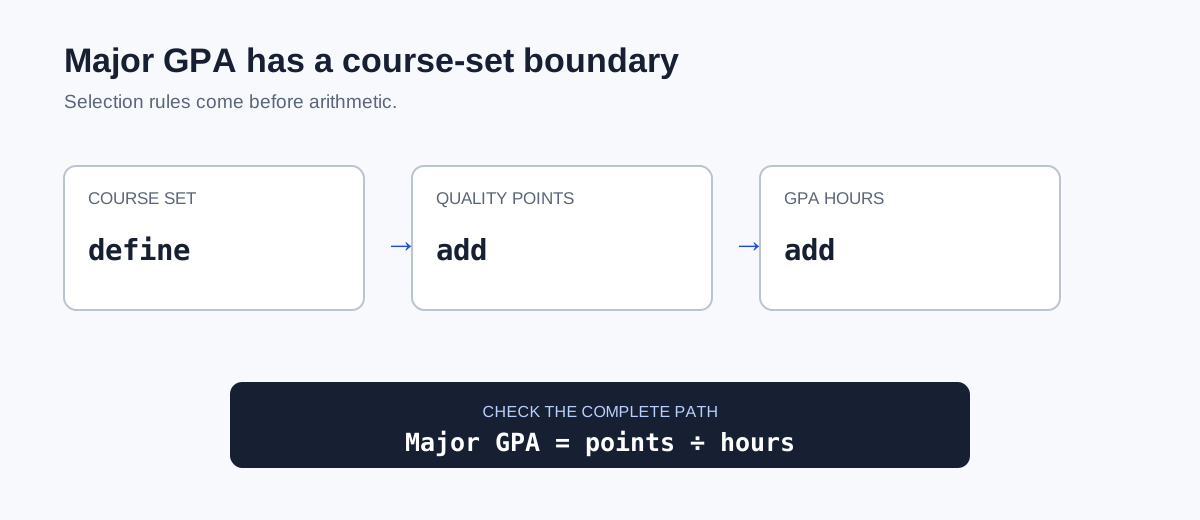
A major GPA is a credit-weighted average for a defined subset of courses. It may include only courses with the department code, all courses required for the degree, or upper-division work. There is no universal selection rule.
Define the course set first
Check the degree audit, catalog, department handbook, or application instructions. Ask whether prerequisites, supporting math or science, electives outside the department, transfer courses, and repeated classes count.
Calculation
Worked example
| Included course | Grade | Points | Credits | Quality points |
|---|---|---|---|---|
| Research Methods | A- | 3.67 | 3 | 11.01 |
| Major Seminar | A | 4.00 | 3 | 12.00 |
| Statistics | B+ | 3.33 | 4 | 13.32 |
| Total | 10 | 36.33 |
How can course-selection rules change a major GPA?
| Possible definition | Courses commonly included | Question to verify |
|---|---|---|
| Department-prefix GPA | Courses carrying the major department code | Do cross-listed courses count? |
| Degree-requirement GPA | Required major courses and approved supporting work | Are prerequisites and outside electives included? |
| Upper-division major GPA | Advanced courses above a catalog-number threshold | What level defines upper division? |
| Application-defined GPA | Courses selected under the employer or program instructions | Does the requester publish its own definition? |
Calculate from a written definition rather than choosing the set that produces the highest number. If no rule is published, disclose the definition used and keep the course list so another person can reproduce the estimate.
Add new major courses to an existing estimate
Convert the previous major GPA back to quality points before adding a new term. For example, a 3.50 major GPA over 30 credits represents 105.00 quality points. Adding the 10-credit, 36.33-point example above produces 141.33 quality points over 40 credits.
The same arithmetic can be modeled in the cumulative GPA calculator after limiting the inputs to courses that meet the chosen major-GPA definition.
How should you report a major GPA?
Do not label a self-calculated number as official. If an employer asks for major GPA and the transcript does not show one, state that it is a self-calculated estimate and be prepared to explain the included courses.
Audit the selected courses
Create two columns before doing any arithmetic: included and excluded. Record the policy reason beside every borderline course. A cross-listed class, required statistics course, internship, or transfer elective can look relevant while falling outside the department's definition. This small audit makes the estimate reproducible and prevents a favorable grade from being included only because it improves the result.
If the definition changes by purpose, calculate separate labeled estimates for the department and the outside application.
Major GPA is not science GPA
A biology major GPA may follow department degree requirements. An AMCAS BCPM GPA follows AAMC course classifications. The selected course sets can differ.
A four-pass check for this method
A reliable major gpa estimate should leave an audit trail, not just a final number. Work through these four passes in order and keep the source for every scale, weight, credit value, and inclusion decision beside the calculation.
- Define the department, course levels, and cross-listed classes included.
- Convert the selected grades with the institution’s point table.
- Multiply by GPA hours and total only the selected course rows.
- Label the result as an estimate unless the institution reports it.
After the four passes, change one input at a time and calculate again. The direction and size of the change should match the rule you documented. Preserve unrounded values until the final display, label hypothetical inputs, and keep institutional results separate from estimates created for planning. If the worksheet still disagrees with an official record, compare the included courses and denominator before assuming the arithmetic is wrong.
Move one borderline course into and out of the selected set. The change shows whether the estimate depends more on arithmetic or on the institution’s definition of the major course boundary. Save the source date with the worksheet so a later policy change does not silently alter the meaning of the estimate.