"Science GPA" can mean different things. AMCAS uses the term BCPM for biology, chemistry, physics, and mathematics. A college, scholarship, or another application service may define science courses differently.
How should courses be classified for BCPM?
The current AAMC course classification guide tells applicants to classify interdisciplinary courses by their primary content. Natural and physical sciences outside the highlighted BCPM classifications are not automatically BCPM. Consult the course description and a prehealth adviser when the fit is unclear.
Estimate the GPA
Worked estimate
| Course | Grade | AMCAS weight | Hours | Quality points |
|---|---|---|---|---|
| General Biology | A- | 3.7 | 4 | 14.8 |
| Organic Chemistry | B+ | 3.3 | 4 | 13.2 |
| Calculus | A | 4.0 | 3 | 12.0 |
| Total | 11 | 40.0 |
Why can the AMCAS BCPM GPA differ from the transcript?
AAMC states that AMCAS GPAs are standardized and often differ from institutional GPAs. Courses with credit hours and letter grades can be included even when a school excluded them from its own GPA. Certain pass/fail, AP, audit, withdrawal, and other course types receive separate treatment.
Build a classification audit
List the transcript course title, department, catalog description, proposed AMCAS classification, credits, and grade. For an interdisciplinary class, save the description showing its primary content. This does not guarantee the classification will remain unchanged during verification, but it makes the estimate consistent and gives a prehealth adviser enough context to review the decision.
Calculate BCPM and AO separately, then confirm that their hours and quality points reconcile with the broader AMCAS undergraduate totals you are estimating.
Enter the transcript, not your estimate
The AAMC grade conversion guide is for personal reference. Follow the current applicant instructions and enter course information as it appears on official records.
Document courses near a classification boundary
An interdisciplinary title alone may not show whether a course belongs in Biology, Chemistry, Physics, or Mathematics. Save the catalog description and note the primary content that supports the proposed classification. For example, a psychology statistics course may use mathematical methods but remain primarily behavioral science, while a biostatistics course can present a different classification question.
Keep the proposed BCPM result and the broader undergraduate GPA in the same worksheet. The BCPM hours plus all other hours should reconcile with the total hours being estimated. If a course moves between categories during verification, its credits and quality points should move together; they should not disappear from the combined total.
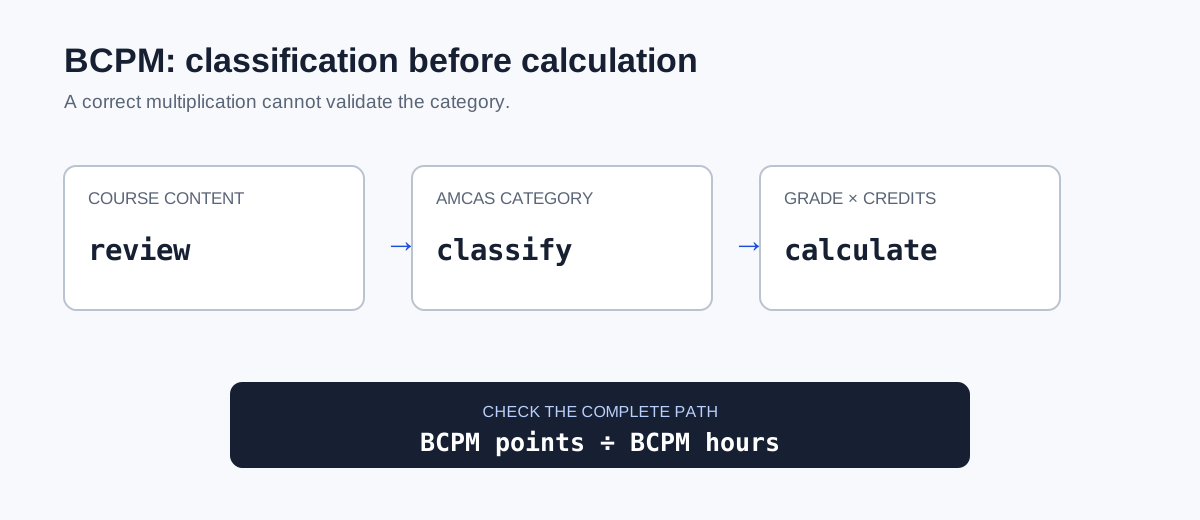
Classification is reviewed separately from arithmetic
A correct multiplication does not prove that a course belongs in a particular application category.
A four-pass check for this method
A reliable science bcpm gpa estimate should leave an audit trail, not just a final number. Work through these four passes in order and keep the source for every scale, weight, credit value, and inclusion decision beside the calculation.
- Inventory transcript courses with titles, credits, grades, and descriptions.
- Classify each course by primary content under current AMCAS guidance.
- Calculate BCPM quality points and hours in their own columns.
- Reconcile BCPM and all-other totals with the broader estimate.
After the four passes, change one input at a time and calculate again. The direction and size of the change should match the rule you documented. Preserve unrounded values until the final display, label hypothetical inputs, and keep institutional results separate from estimates created for planning. If the worksheet still disagrees with an official record, compare the included courses and denominator before assuming the arithmetic is wrong.
Move one borderline course between BCPM and all-other categories while keeping it in the combined total. Its credits and quality points must move together. Save the source date with the worksheet so a later policy change does not silently alter the meaning of the estimate.
Sources
- AAMC: Grades and GPA Calculations
- AAMC: Course Classification Guide
- AAMC: Grades Included in AMCAS GPAs
For an informal projection using a carefully selected science-course subset, the cumulative GPA calculator can combine prior points and new courses. It does not replace an AAMC classification or verified AMCAS calculation.