Weighted and unweighted GPA answer different questions. The unweighted number summarizes the grades earned without giving extra points for course level. The weighted number attempts to represent both grades and academic difficulty.
The difference in one table
| Question | Unweighted GPA | Weighted GPA |
|---|---|---|
| Common top value | 4.0 | Often 4.5, 5.0, or higher |
| Course rigor bonus | None | May add points for Honors, AP, IB, or dual enrollment |
| Best use | Compare grade performance on one scale | Review grades together with course difficulty |
| Universal formula | No | No |
The word often matters. There is no single national weighted scale. College Board materials note that high schools calculate GPA in different ways, and colleges may remove or replace a high school's weighting when reviewing applications.
The same four courses, two results
This worked example uses a common local policy: Honors adds 0.5 and AP / IB adds 1.0. All four courses carry one credit.
| Course | Grade | Unweighted points | Bonus | Weighted points |
|---|---|---|---|---|
| English 11 | A- | 3.70 | 0.00 | 3.70 |
| AP Biology | B+ | 3.30 | 1.00 | 4.30 |
| Algebra II Honors | A | 4.00 | 0.50 | 4.50 |
| US History | B | 3.00 | 0.00 | 3.00 |
| Total | 14.00 | 15.50 |
Why weighted scales vary
A school can choose which courses receive weight and how much. Some add 1.0 for both AP and Honors. Some add 1.0 for AP but 0.5 for Honors. Others use a separate grade table instead of a flat bonus.
- A B in an AP course might be worth 4.0, 4.3, or another value depending on policy.
- An honors course approved at one school may be treated as regular at another.
- Some schools cap weighted points at 5.0. Others allow a higher maximum.
- Some GPAs include every class. Others use academic core courses only.
AP course grade is not the AP Exam score
The classroom grade is used in a high school's GPA according to local policy. The separate AP Exam score runs from 1 to 5 and is used by colleges for their own credit or placement decisions.
Which GPA do colleges use?
There is no universal answer. Colleges receive the transcript and school profile, then may use the reported GPA or recalculate it. College Board guidance explains that some colleges focus on core subjects, remove noncore courses, or standardize the weighting used by different high schools.
For planning, keep both numbers. Use unweighted GPA to understand the grade pattern. Use weighted GPA to model the policy printed by your high school. Do not assume either number reproduces an admission office's internal calculation.
Which number should you enter on a form?
Follow the form's instructions. If it asks for the GPA exactly as reported, copy the transcript and select the corresponding scale. If it asks for unweighted GPA and your transcript only shows weighted GPA, ask your counselor rather than trying to reverse the weighting from the final number.
Choose the number by purpose, not by size
A weighted GPA is often numerically higher, but that does not make it the correct answer to every form. Use the label and scale attached to the official transcript. If a form requests an unweighted value, supply the school’s unweighted figure or ask the counselor how to report it; do not subtract a guessed bonus from the final GPA.
| Situation | Use first | What to verify |
|---|---|---|
| Checking your transcript | The value printed on the record | Scale, included terms, and GPA credits |
| Planning future grades | Both weighted and unweighted scenarios | Current school bonus rules |
| Application asks for reported GPA | Exact transcript value | Whether the form also asks for scale |
| Application asks for unweighted GPA | School-provided unweighted value | Counselor instructions when none is printed |
Do not compare unlike denominators
Two students can use the same weighting bonuses and still have GPAs that are not directly comparable if their schools include different subjects or count semesters differently. Course rigor, grading scale, credits, and the set of included courses all affect the result. Record those assumptions beside any comparison.
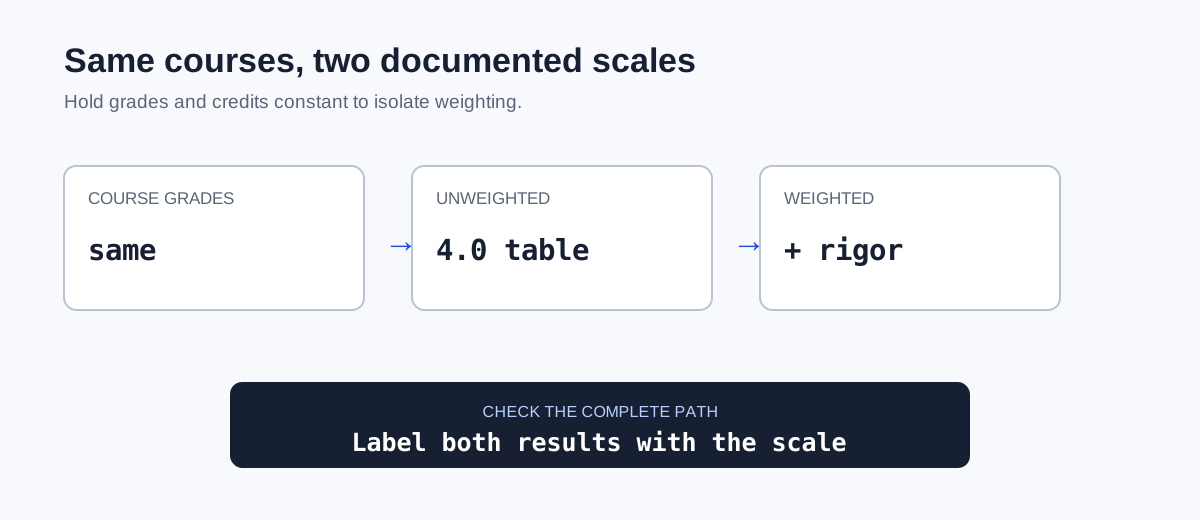
Preserve one shared course list
When comparing weighted and unweighted results for planning, calculate both from the same grades and credits. Change only the rigor bonus. That isolates the effect of weighting and avoids attributing a course-list difference to the GPA scale.
A four-pass check for this method
A reliable weighted vs unweighted gpa estimate should leave an audit trail, not just a final number. Work through these four passes in order and keep the source for every scale, weight, credit value, and inclusion decision beside the calculation.
- Convert the same course grades with the unweighted point table.
- Recalculate only approved advanced courses with the weighted table.
- Apply identical credits and course inclusion rules to both versions.
- Label both results with their scale instead of comparing bare numbers.
After the four passes, change one input at a time and calculate again. The direction and size of the change should match the rule you documented. Preserve unrounded values until the final display, label hypothetical inputs, and keep institutional results separate from estimates created for planning. If the worksheet still disagrees with an official record, compare the included courses and denominator before assuming the arithmetic is wrong.
Hold course grades, credits, and included rows constant. The difference between the two results should come only from approved rigor adjustments in the weighted table. Save the source date with the worksheet so a later policy change does not silently alter the meaning of the estimate.
Sources
- College Board BigFuture: How to Calculate Your GPA on a 4.0 Scale
- College Board: The High School Transcript
- College Board AP Students: Difference between AP and Honors courses
Enter one course list in the weighted GPA calculator to compare both results without changing credits or grades between calculations.