A weighted GPA gives additional grade points to designated advanced courses. It is meant to record course rigor alongside performance, but there is no single US weighted scale. Two high schools can assign different weighted points to the same letter grade.
AP course grade and AP Exam score are different
The AP course grade comes from the school and may enter the high school GPA. The AP Exam receives a score from 1 to 5. Colleges can use that exam score for placement or credit, but it is not the same as a five-point course grade.
College Board also distinguishes AP from Honors: AP courses follow a college-level framework and culminate in an optional standardized AP Exam, while Honors courses are developed by schools and teachers. That distinction does not create a universal GPA bonus for either course type.
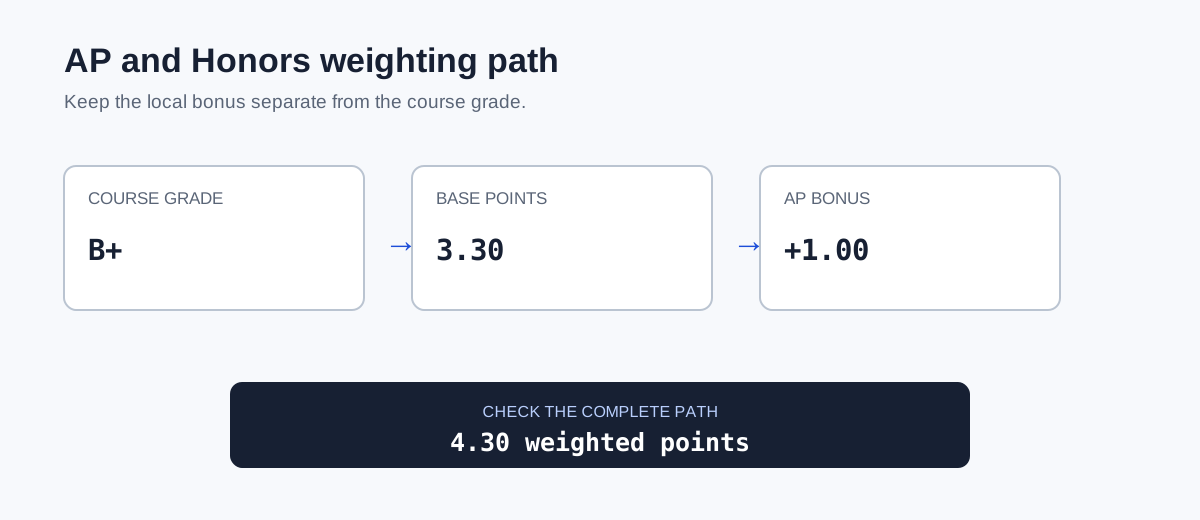
One common bonus model
GradeHorizon currently demonstrates a simple local model: add 0.5 to Honors courses and 1.0 to AP or IB courses, with weighted points capped at 5.0. Use it only when it matches the handbook.
| Letter grade | Regular | Honors (+0.5) | AP / IB (+1.0) |
|---|---|---|---|
| A | 4.00 | 4.50 | 5.00 |
| A- | 3.70 | 4.20 | 4.70 |
| B+ | 3.30 | 3.80 | 4.30 |
| B | 3.00 | 3.50 | 4.00 |
| C | 2.00 | 2.50 | 3.00 |
| F | 0.00 | Check policy | Check policy |
Why the F row says check policy
Some scales add no rigor bonus to a failing grade. Others define weighting with a complete points table instead of a flat bonus. Never assume the same addition applies to every letter grade.
Worked example with credits
Three courses on the example scale
| Course | Grade | Level | Credits | Weighted quality points |
|---|---|---|---|---|
| AP Biology | B+ | AP | 1.0 | 4.30 |
| Honors English | A- | Honors | 1.0 | 4.20 |
| US History | A | Regular | 1.0 | 4.00 |
| Total | 3.0 | 12.50 |
Five policy details to verify
- Eligible labels: The school may weight AP and IB but not Honors, or may approve only certain Honors courses.
- Bonus size: A school can add 0.5, 1.0, or use a separate points table.
- Grade restrictions: Bonuses may apply only to grades of C or higher.
- Caps: Weighted points or the number of weighted courses can be limited.
- Course source: Online, dual-enrollment, transfer, or middle-school courses can receive different treatment.
College Board's sample school profile specifically includes GPA calculation and weighting details because colleges need the high school's context to interpret a transcript.
Will a college use the weighted GPA shown?
Not necessarily. A college may review the high school's reported GPA, recalculate selected academic subjects, or consider course rigor separately. The calculation on this site estimates a school-style result. It does not claim to reproduce a particular college's admission review.
Should you choose AP or Honors for the GPA bonus?
The bonus is only one part of the decision. Compare prerequisites, workload, subject preparation, teacher guidance, graduation requirements, and your capacity across the entire schedule. A more advanced label does not guarantee a higher weighted grade or a better educational outcome.
A four-pass check for this method
A reliable ap honors gpa weighting estimate should leave an audit trail, not just a final number. Work through these four passes in order and keep the source for every scale, weight, credit value, and inclusion decision beside the calculation.
- Copy the school’s regular, Honors, AP, and IB point values.
- Match each course to the level the school recognizes.
- Multiply the resulting grade points by course credits.
- Add quality points and divide by the included credits.
After the four passes, change one input at a time and calculate again. The direction and size of the change should match the rule you documented. Preserve unrounded values until the final display, label hypothetical inputs, and keep institutional results separate from estimates created for planning. If the worksheet still disagrees with an official record, compare the included courses and denominator before assuming the arithmetic is wrong.
Compare one advanced course with the same grade in a regular course. The difference should equal the documented rigor bonus before credits, caps, or grade restrictions are applied. Save the source date with the worksheet so a later policy change does not silently alter the meaning of the estimate.
Sources
- College Board: What is the difference between AP and Honors courses?
- College Board: Sample High School Profile
- College Board BigFuture: How to Calculate Your GPA on a 4.0 Scale
After confirming the bonus rules in your school handbook, enter the same courses in the weighted GPA calculator to compare the weighted and unweighted results with identical credits.