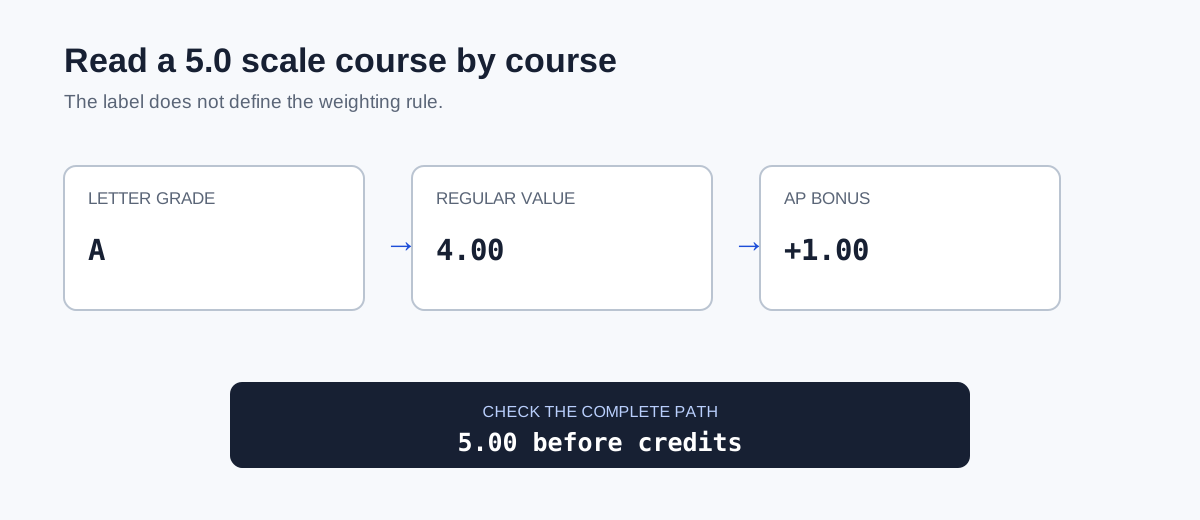
The phrase "5.0 scale" describes many different high school systems. A common model adds one point to AP or IB grades and half a point to Honors grades. Other schools use a separate table, restrict eligible courses, or cap how much weight counts.
Example scale
| Grade | Regular | Honors | AP / IB |
|---|---|---|---|
| A | 4.0 | 4.5 | 5.0 |
| A- | 3.7 | 4.2 | 4.7 |
| B+ | 3.3 | 3.8 | 4.3 |
| B | 3.0 | 3.5 | 4.0 |
This table is a transparent planning assumption, not a national standard.
Worked weighted example
An A in regular English contributes 4.0 points. A B+ in AP Biology contributes 4.3. An A- in Honors Algebra contributes 4.2. With equal credits:
Can GPA be above 5.0?
It can under a scale that awards more than five points or weights additional course types. The number has meaning only with the scale and school profile. A 4.6 on one system is not automatically stronger than a 4.2 on another.
Which 5.0-scale rules should you check?
- Which courses receive weight?
- Does every passing grade receive the bonus?
- Are weighted points capped per course or overall?
- Does class rank use the same GPA?
- Are transfer and dual-enrollment courses weighted?
Compare students through the school context
A weighted number cannot be interpreted without knowing which advanced courses were available and how the school weighted them. This is one reason high school profiles describe curriculum and GPA policy. For personal planning, compare the same student's scenarios under one scale rather than ranking unrelated scales.
If a calculator offers a 5.0 preset, inspect the point table. A label alone does not reveal whether Honors receives 0.5, whether AP receives 1.0, or whether low grades receive any bonus.
Report both versions when available
Weighted GPA shows performance under the local rigor policy. Unweighted GPA shows the same grades on the base scale. Keeping both prevents the scale label from hiding the underlying grades.
Translate the scale before comparing results
Write the grade-point table next to any weighted GPA. A “5.0 scale” may mean AP A = 5.0 and Honors A = 4.5, but another school can award the same bonus to both course types or restrict bonuses to particular grades. The label does not define the rule.
When comparing two planning scenarios, keep grades, credits, and included courses identical and change only the weighting table. The difference then shows the effect of the policy rather than a different schedule. When comparing official records from different schools, rely on each school profile and transcript context instead of converting one final GPA with a guessed ratio.
Never divide by five and multiply by four
A weighted scale is usually not a linear percentage scale. Converting only the final number loses course-level bonuses and inclusion rules.
Report the number with its scale and source
When a form asks for GPA and scale, use the transcript value and the scale identified by the school. Do not choose 5.0 merely because an advanced course can earn five points; some schools still report an official GPA on another maximum or include a separate unweighted figure.
If the form asks for an unweighted value that the transcript does not show, ask the counselor or issuing school for guidance. Reversing a weighted cumulative GPA is generally impossible without the original course grades, credits, and bonus rules.
A four-pass check for this method
A reliable gpa on 5 point scale estimate should leave an audit trail, not just a final number. Work through these four passes in order and keep the source for every scale, weight, credit value, and inclusion decision beside the calculation.
- Copy the school’s course-level point table instead of assuming a universal scale.
- Convert every final course grade with that same table.
- Apply course credits and any stated limits on weighted points.
- Report the result with the scale and policy source attached.
After the four passes, change one input at a time and calculate again. The direction and size of the change should match the rule you documented. Preserve unrounded values until the final display, label hypothetical inputs, and keep institutional results separate from estimates created for planning. If the worksheet still disagrees with an official record, compare the included courses and denominator before assuming the arithmetic is wrong.
Test one regular and one advanced course at the same letter grade. That comparison reveals the actual bonus more clearly than the scale’s advertised maximum. Save the source date with the worksheet so a later policy change does not silently alter the meaning of the estimate.
Sources
Use the weighted GPA calculator to apply the published Honors and AP / IB bonuses course by course, then compare the result with your school’s actual 5.0-scale policy.