Most US high schools start with final course grades, convert them to grade points, and combine them using course credits. The arithmetic is simple. The policy is not. Schools can differ on plus and minus grades, AP and Honors bonuses, repeated courses, middle-school credits, and whether every subject enters GPA.
The basic high school formula
If every class has equal credit, averaging the grade points gives the same result. When a semester course is worth 0.5 credit and a year course is worth 1.0, use the full credit-weighted formula.
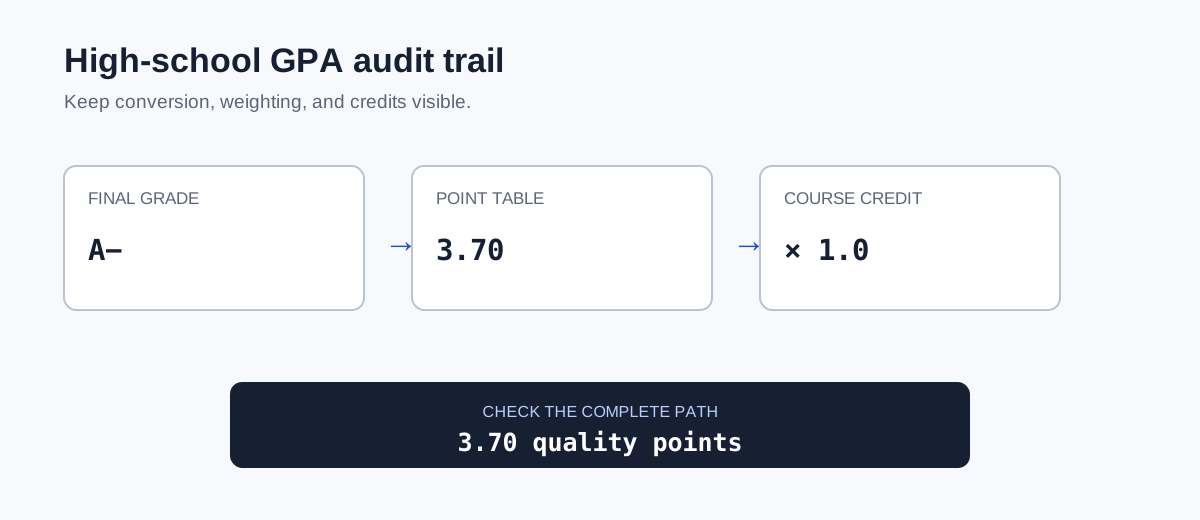
Worked four-course example
| Course | Grade | Points | Credits | Quality points |
|---|---|---|---|---|
| English | A | 4.0 | 1.0 | 4.0 |
| Algebra II | B+ | 3.3 | 1.0 | 3.3 |
| Biology | A- | 3.7 | 1.0 | 3.7 |
| Health | B | 3.0 | 0.5 | 1.5 |
How do weighted and unweighted records differ?
An unweighted GPA uses the base grade scale. A weighted GPA adds points or uses a separate table for approved advanced courses. There is no national 5.0 system. College Board advises students to use the scale reported by their school, and a school profile commonly explains the local weighting rules to colleges.
What should you check on the transcript?
- Does the school award plus and minus values?
- Are semester courses worth half a credit?
- Which AP, IB, Honors, or dual-enrollment courses receive weight?
- Do middle-school courses appear in the high school GPA?
- Are repeated courses replaced or counted together?
Reported GPA and college review are not identical
A college may read the reported GPA in context, recalculate selected academic subjects, or evaluate course rigor separately. A planning estimate cannot reproduce every admission process.
Audit a high school GPA in two passes
The first pass should reproduce the unweighted arithmetic. Copy each final course grade, its GPA credit, and the grade-point value from the school’s own scale. Add quality points and credits without introducing rigor bonuses. If the result differs from the transcript, investigate included courses, repeated grades, and rounding before moving on.
The second pass adds only the weighting rule printed in the school profile or handbook. Mark the specific courses that receive Honors, AP, IB, or dual-enrollment weight and record the bonus used. This separation shows whether a mismatch comes from the base record or from advanced-course weighting.
| Transcript field | Why it matters | Check against |
|---|---|---|
| Final course grade | Sets base grade points | Transcript key or handbook scale |
| GPA credit | Sets each course’s influence | Credit column and course length |
| Course level | May trigger local weighting | School profile and approved course list |
| Term label | Prevents duplicate counting | Semester, year, and cumulative periods |
| Repeat or pass/fail code | Can change inclusion | Written academic policy |
Document the result you are reproducing
Label the calculation with school year, grading period, scale, and whether it is weighted. A correct semester unweighted GPA is not expected to equal a cumulative weighted GPA. Clear labels prevent a valid calculation from being treated as an error simply because it answers a different question.
Change one input at a time when planning
To understand what can improve the result, keep the course list, credits, and scale fixed while changing only the future grade being tested. Then run a separate scenario for a different schedule or rigor level. Combining several assumptions in one worksheet makes it impossible to see whether the GPA moved because of a grade, a bonus, or a credit change.
Preserve the official-record calculation in a separate copy. A planning scenario is useful only when it cannot silently overwrite the transcript audit it started from.
A four-pass check for this method
A reliable high school gpa explained estimate should leave an audit trail, not just a final number. Work through these four passes in order and keep the source for every scale, weight, credit value, and inclusion decision beside the calculation.
- Choose the exact grade scale and the transcript’s included courses.
- Convert each final course grade to grade points.
- Apply credits and approved rigor bonuses separately.
- Compare the estimate with the school-reported record and policy.
After the four passes, change one input at a time and calculate again. The direction and size of the change should match the rule you documented. Preserve unrounded values until the final display, label hypothetical inputs, and keep institutional results separate from estimates created for planning. If the worksheet still disagrees with an official record, compare the included courses and denominator before assuming the arithmetic is wrong.
Calculate one unweighted pass first, then add only the rigor adjustments the handbook allows. Keeping the passes separate makes an incorrect AP or Honors bonus easy to find. Save the source date with the worksheet so a later policy change does not silently alter the meaning of the estimate.
Sources
Once you confirm the transcript’s grade-point table and included credits, reproduce the calculation in the high school GPA calculator.