A semester grade can be a simple average of two quarters, but many schools also assign a separate final exam weight. Use the exact formula from the course or district policy.
Example formula
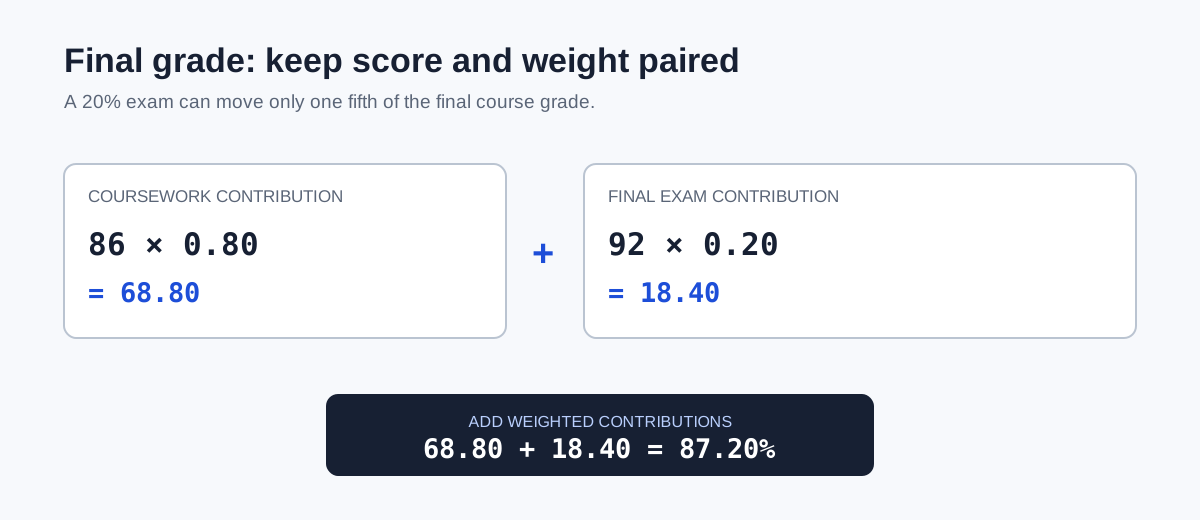
Worked example
| Component | Score | Weight | Contribution |
|---|---|---|---|
| Quarter 1 | 88 | 42.5% | 37.40 |
| Quarter 2 | 92 | 42.5% | 39.10 |
| Semester exam | 84 | 15% | 12.60 |
| Total | 100% | 89.10 |
Three common semester structures
| Structure | Example weights | Calculation note |
|---|---|---|
| Two quarters only | 50% + 50% | Average the two quarter grades when they carry equal weight. |
| Two quarters plus exam | 42.5% + 42.5% + 15% | Apply the exam once as a separate component. |
| Four quarters plus exam | 20% each quarter + 20% exam | Confirm whether the result is a semester or full-year grade. |
Schools may instead use 40/40/20, 45/45/10, total points, or an exam-replacement rule. The formula is valid only when its weights match the published grading policy.
Solve for a needed semester-exam score
When the exam is the only unknown component, first add the weighted contributions from completed quarters. Subtract that total from the desired semester grade, then divide by the exam weight.
For quarter grades of 88 and 92 at 42.5 percent each, the completed contribution is 76.50. Reaching a 90 semester grade with a 15 percent exam requires (90 - 76.50) ÷ 0.15 = 90 on the exam.
The semester grade calculator supports both forward calculations and needed-exam scenarios.
Which semester-grade variations change the formula?
- Two quarters count 50 percent each and there is no separate exam.
- The exam replaces a low test grade inside quarter 2.
- Four quarters create a full-year grade.
- Letter grades are converted through a district table rather than averaged as percentages.
When does the semester grade enter GPA?
A semester course grade can later be converted to grade points for GPA. Do not average the quarter percentages again after an official final course grade has already been issued.
Check the result against the gradebook
Rebuild the estimate with one contribution per component. If the displayed semester grade differs, check whether the gradebook has already rounded quarter grades, whether an assignment remains ungraded, or whether the exam weight is applied inside a category. A difference of several points usually signals a weight or denominator problem, not ordinary rounding.
For planning, test a low, expected, and high exam score. Three scenarios are more useful than one optimistic forecast because they show the range that the remaining weight can still produce.
Do not assume 40 / 40 / 20
That pattern is common enough to appear in calculators, but it is not universal. Label every result with the weights used.
Test how much the remaining exam can change
The remaining weight sets the maximum movement. With quarter contributions already fixed, every one-point change on a 10 percent exam changes the semester result by only 0.1 point. The same one-point exam change is worth 0.2 point when the exam carries 20 percent.
| Exam weight | Effect of a 10-point exam increase | Planning meaning |
|---|---|---|
| 10% | +1.0 semester point | Quarter grades dominate |
| 15% | +1.5 semester points | Exam can move a nearby letter cutoff |
| 20% | +2.0 semester points | Exam has stronger leverage |
Use this relationship to catch unrealistic expectations. If completed contributions total 82 points and only 10 percent remains, even a 100 on the exam produces 92—not a value above 100. Conversely, a low exam cannot erase more than its assigned weight unless the policy includes a separate penalty or replacement rule.
Keep displayed and raw grades separate
A gradebook may display a rounded quarter grade while retaining a more precise value internally. If the official system uses raw values, rebuilding the calculation from rounded numbers can differ by a few hundredths. Label the values you used and avoid rounding each weighted contribution before adding them.